What Roof Flashing Does and Why It Leaks
Flashing is the metal at the joints of your roof, and it is the most common place a roof leaks. If there is a stain near a chimney, a wall or a vent, we come out to Beaumont homes and look at no charge.
Free, no-obligation estimates. We answer the phone or call back the same working day.
What Roof Flashing Does
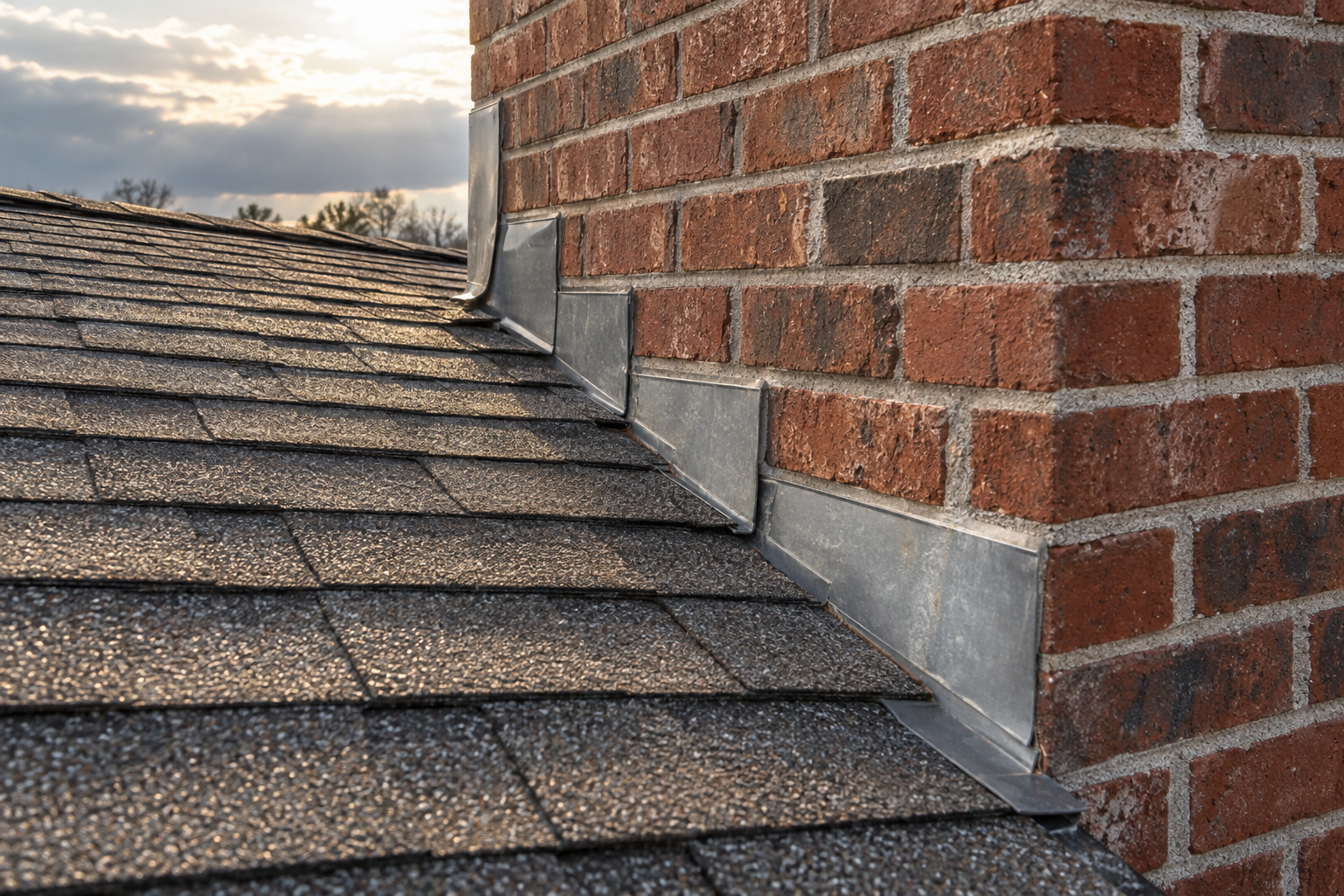
"Flashing" is the sheet metal at the walls, chimneys, valleys, pipes and edges of a roof, bent to turn water away from the joints where the roof meets something else.
Shingles shed water well on the open slope, where each course laps over the one below it. They cannot close a joint on their own: the line where a slope runs into a wall, the gap around a chimney or a vent pipe, the crease where two slopes meet, the edge where the roof stops.
At each of those joints a piece of metal is cut, bent and lapped in with the shingles so water running down the roof is carried over the joint instead of into it. You may know it as the metal around the chimney, or just the roof metal.
Where flashing sits
- Wallswhere a slope runs up into siding or brick
- Chimneysaround all sides of the brick
- Valleyswhere two slopes meet and pour into one line
- Pipesaround every vent that comes through the roof
- Edgesalong the eaves and rakes
Each one is a hole or a seam in the roof that only the metal keeps dry.
Kinds of Flashing
These are the kinds of flashing on a house, each made for one kind of joint.
Step flashing
Short bent pieces woven in with each course of shingles where the roof runs up against a wall, so every course laps over a piece of its own. This is the flashing where the roof meets the wall.
Counterflashing
Also called "cap flashing": metal set into the wall or the chimney's mortar and folded down over the step flashing, so water running down the brick cannot get behind it.
Valley metal
Metal laid in the valley, where two slopes meet and carry the water of both down one line. It takes more water than any other joint on the roof.
Drip edge
The edge metal at the eaves and rakes that carries water off the roof and clear of the fascia. It holds best hemmed and set on a continuous cleat.
Pipe boots
The rubber collar around a vent pipe that seals the hole where the pipe comes through. It splits at the collar long before the roof around it wears out.
Chimney shrouds
A sheet-metal cover over the top of a chimney. Like drip edges and valleys, it is one of the custom sheet-metal parts cut and bent to fit the house.
Skylights get a set of their own: step flashing up the sides, an "ice-and-water membrane" under it, and sealed transitions at the corners.
Why Flashing Leaks
Flashing leaks because it sits at the joints, and the joints are where a roof fails first, long before the open slope.
Most flashing relies on a seal somewhere, and a "sealant bond" that has opened once rarely seals again reliably. A joint that has started letting water in keeps letting it in, a little more with every storm.
That is why tracing a leak runs joint by joint in a set order. After the edges, the roofer checks:
- Pipe bootssplit collars around the vents
- Step flashing at the wallslifted or rusted pieces along each wall line
- Valley metalworn or buried metal where slopes meet
- Hip and ridge capthe caps along the peaks, nailed closest to the top
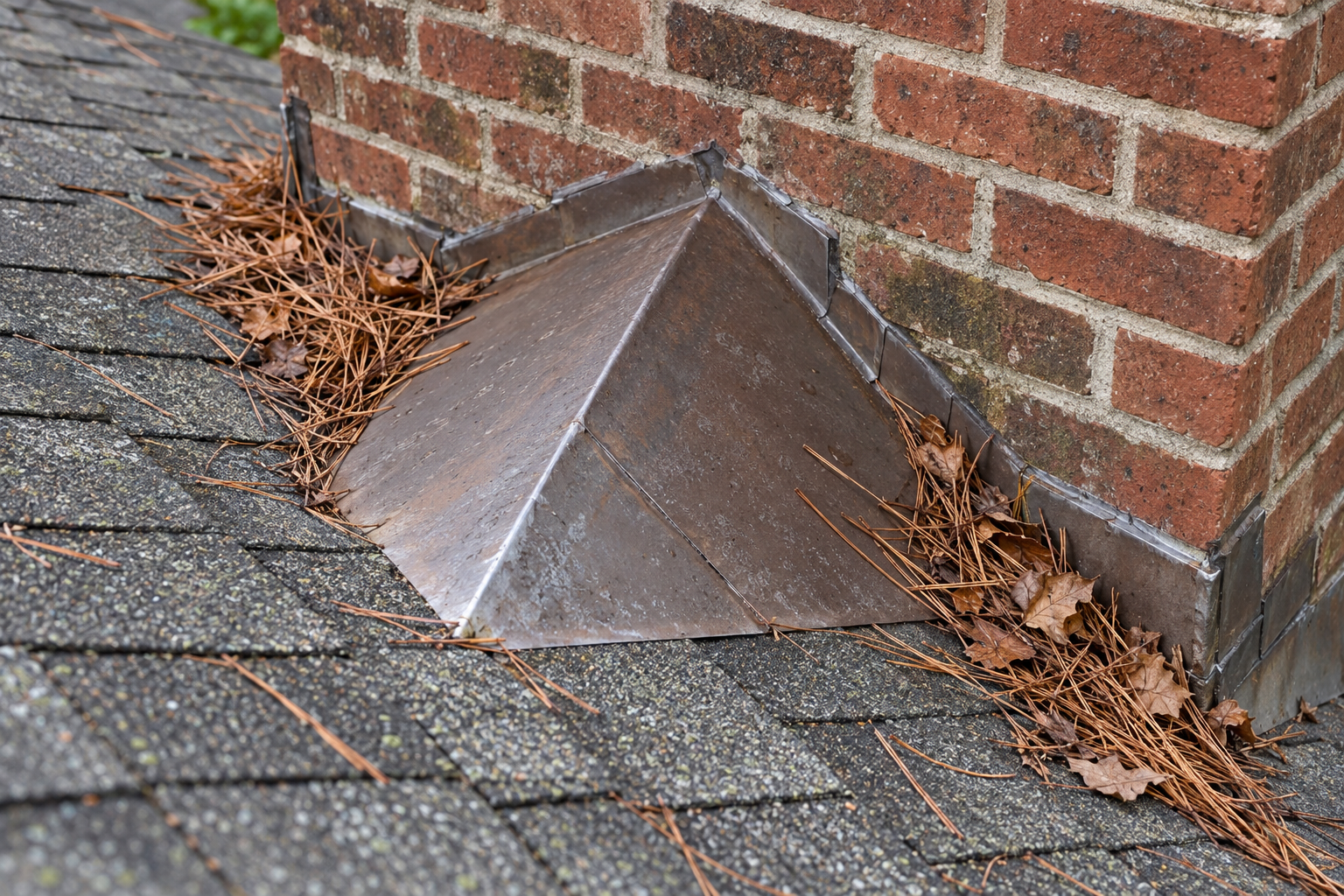
Behind a chimney, the small peak called the "cricket" splits the water around the brick. It has to be kept clear: needles and leaves piled there hold water against the metal.
Fixing Failed Flashing
A roofer fixes failed flashing, and a failed pipe boot, valley or counterflashing is a detail rebuild, not a dab of sealant.
Repairs come in tiers. A broken seal or a few displaced tabs is a course-level fix. A failed boot, a bad valley or open counterflashing is the larger job: the shingles around the joint come up, the old metal or boot comes out, and new pieces go in lapped the right way, to the flashing details the National Roofing Contractors Association publishes as the industry reference.
Sealant smeared over the joint may stop the drip for a while, but the seal under it has already opened, and it rarely holds.
-
Water stain on a ceiling or wall
A rebuilt joint is often the end of a leak traced from the stain inside back up to the roof.
-
Drip around a skylight
A leaking skylight is usually its step flashing and seals, and the unit itself can often stay.
Neighbors on the work
These are our Google reviews, as our customers wrote them.
-
Chilo was super quick to respond and come by for a quote. I only needed minor repairs, but the work was done quickly (within the day) and for a fair price.
Google review -
I am so happy I called IH roofing. My new roof looks great. I called 5 roofing companies and the bid from IH roofing was very competitive. $1000's less than the big companies. I told them my need was dire and they put me right into their calendar. They worked from 8am to dark and had my roof completed in under two days. The crew was courteous and they left my yard cleaner than they found it. I recommend I H roofing without any hesitation.
Google review -
Professional and did an outstanding job on replacing shingles and bad areas that was found on my roof. I highly recommend IH Roofing.
Google review
Water getting in at a joint?
Call and we come out, trace it to the flashing that failed and put the price for the fix in writing.
We show up when we say we will.